
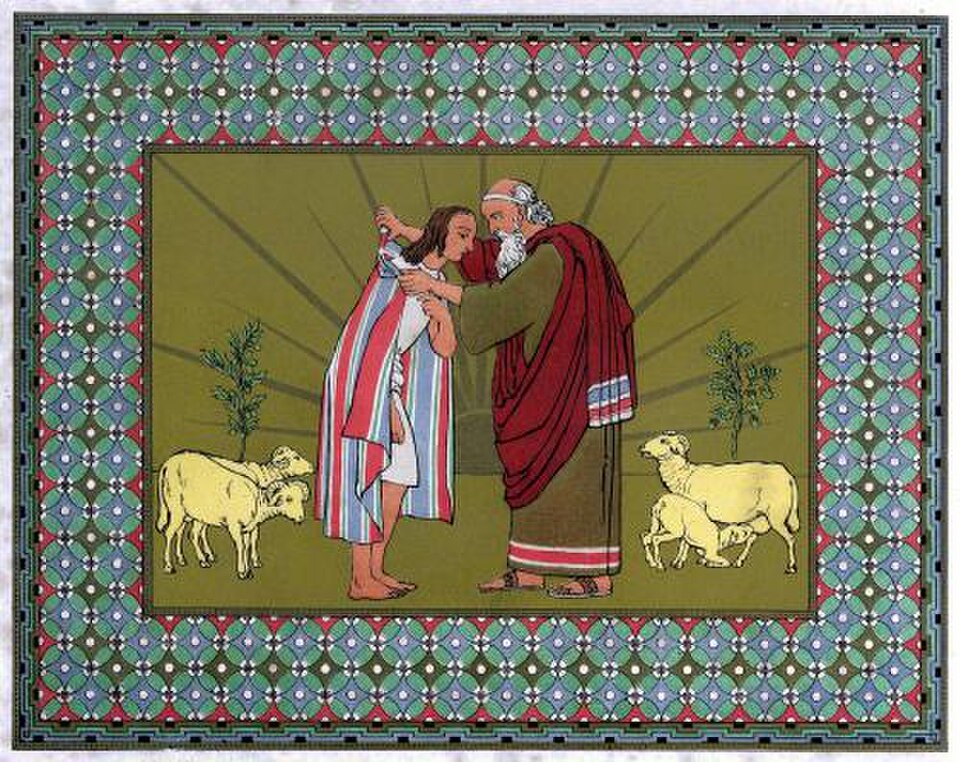
Jacob has twelve sons, but he loves Joseph with a love that does not hide itself. His special love is expressed by making for him a ketonet passim, a special garment, and he does not seem to consider what the sight of it will do to the other eleven. What he meant as a gift of love turns out to be an object of envy, family division, and hatred. They watch their brother move through the house dressed in distinction, and something hardens in them. Genesis 37:4 says it plainly: they hated him and could not speak to him in shalom.
A piece of clothing has broken a family.
But the coat is not simply the cause of a domestic dispute. There is something that happens every time Joseph’s clothing changes. From his incident with his brothers in the field to Pharaoh giving him a new tunic, each moment marks a turn in the plot— a descent, a crisis, a reversal. By the time the story is finished, you realise that the narrator has been doing something deliberate all along. Clothing in the Joseph cycle is not decoration. It is theology.
What is a Ketonet Passim?
The Hebrew phrase כְּתֹנֶת פַּסִּים (ketonet passim) appears only twice in the Hebrew Bible — here in Genesis 37, and again in 2 Samuel 13:18–19.
Ketonet (כְּתֹנֶת) is the standard word for a tunic or long garment. It is the same word used in Genesis 3:21, where God makes garments of skin for Adam and Eve, the first clothing in Scripture, given to cover shame. The weight of that origin is worth noting because clothing, from the beginning, marks a change in human status.
Passim (פַּסִּים) is harder to pin down. The word appears to derive from pas (פַּס), meaning “palm” or “flat of the hand,” and by extension, “extremity.” Most translations render ketonet passim as “a coat of many colours” (following the Septuagint’s χιτῶνα ποικίλον, chitōna poikilon, “an ornamented tunic”) or “a long robe with sleeves.”1 The debate between these readings is less important than what both agree on: this is a garment of distinction. It marks its wearer as set apart.2
The second occurrence of this phrase confirms this. In 2 Samuel 13:18–19, Tamar, David’s daughter, a princess of the royal house, wears a ketonet passim. The narrator explains that “for thus were the virgin daughters of the king dressed.” The garment is royal. It signals status, honour, and a specific kind of protected identity. When Amnon violates Tamar and sends her away, she tears the ketonet passim and goes away crying. The destruction of the garment reflects the destruction of her honour.3
So, Jacob did not give his son a coat of many colours. No, he gave him a tunic that distinguished Joseph as having a higher, royal status among his brothers. His brothers do not miss the signal. They were not angry because they did not get new clothes. It was deeper than that.
Seeing the Pattern
The ketonet passim is only the beginning. Track the clothing through the full Joseph cycle, and a pattern emerges, one that is too precise to be accidental.4
Genesis 37:23 — The Coat Stripped. When Joseph arrives at Dothan, his brothers seize him and strip off his coat. They do not simply remove it; they take it from him. Everything the coat represented (favour, status, his father’s love made visible) is torn away. They throw him into a pit: empty and without water. The pit is a grave that has not yet killed him. Then they sit down to eat.
Genesis 37:31–33 — The Coat Bloodied. The brothers kill a goat, dip the coat in blood, and bring it to Jacob. “This we found, is it your son’s coat?” Jacob recognises it immediately. He concludes that Joseph is dead. The coat, which once made Joseph visible as the beloved son, now announces his death. It speaks on his behalf, albeit falsely.
Genesis 39:12–20 — The Garment Left Behind. In Potiphar’s house, Joseph prospers. He has been elevated again after his master trusted him with everything. But Potiphar’s wife longs for a steamy moment with the fine young man. So, she gets an opportunity and tries to rape him. Joseph refuses, and as he runs away, she grabs his outer garment, and he leaves it in her hand. The cunning woman twists the story and uses his clothing as evidence that Joseph wanted to rape her: “He left his garment with me.” The garment, again, speaks, and again, it lies. Joseph has done nothing wrong; the garment testifies against him. He descends into prison, another pit, because of a piece of clothing.
Genesis 41:14 — He Changed His Clothes. Pharaoh has a dream that troubles him. He sends for Joseph, since the boy has picked up a reputation for being a dream interpreter. Before he goes up to stand before the most powerful man in Egypt, Joseph shaves and changes his clothes. It is a small detail, easily passed over. But it is significant: he is preparing himself for something new.
Genesis 41:42 — Pharaoh Clothes Joseph. After Joseph successfully gets the job of being the second most powerful man in Egypt, Pharaoh takes his signet ring and puts it on Joseph’s hand. He dresses him in garments of fine linen and puts a gold chain around his neck. What the father began, the king completes. Jacob dressed Joseph as a prince among his brothers; Pharaoh dressed him as the second ruler of Egypt. The garment, for the first time in the story, does not lie. It says exactly what is true: this man has been given authority over all the land.
As you can see, clothing plays an important role in the Joseph story. When Joseph is stripped of his garment, he descends into a pit. However, when he puts on new clothes, he rises from the pit.
The Presence of God
As I have mentioned, clothing plays a significant theological role in Josepha’s story. Every time Joseph is stripped or his clothing is used against him, the story appears to be ending. The coat in the pit makes you think this is the end of Joseph. But, no, the story continues. The garment with Potiphar’s wife makes you think that surely now the young man is undone. But the story keeps going. It leaves us with a conclusion that something is at work beneath the surface of each disaster, carrying Joseph forward through every stripping toward a robing that no human hand could have arranged.
The Joseph cycle is a story about providence, but providence of a particular kind. It does not work around suffering – It works through it. Joseph does not avoid the pit; he goes into it. He does not avoid prison; he goes into it. And at each low point, the text quietly notes that God is with him (39:2, 39:21, 39:23). God’s presence is not contingent on Joseph’s circumstances. It accompanies him downward.5
This is what makes the final robing so powerful. When Pharaoh places fine linen on Joseph’s shoulders, he is not reversing the story: He is completing it. The coat the brothers tore off is the same coat Pharaoh puts on, not literally, but theologically. Through this story, we are meant to see that every setback does not mean the story is over, even if God is present. God was with Joseph throughout his life. When everything had been done, and Joseph was reunited with his brothers, he says something that captures his whole life’s story, and possibly the entire biblical story: “Even though you intended to do harm to me, God intended it for good, in order to preserve a numerous people, as he is doing today” (Genesis 50:20).
The Joseph Story Series
Over the coming weeks, I will be writing through the Joseph story. This is one of the fascinating stories in the Bible, both because of its literary genius and its theological significance to the whole biblical story. It is a story about God’s faithfulness, human betrayal, and the strange ways by which redemption travels.
Notes
1 The translation “coat of many colours” follows the Septuagint (χιτῶνα ποικίλον) and was popularised by the KJV. Victor P. Hamilton argues that “long robe with sleeves” is the more defensible rendering. He understands passim as referring to the extremities of the body—palms and soles—and thus a garment that covered the full length of the arms and legs, distinguishing its wearer from those who laboured. Victor P. Hamilton, The Book of Genesis: Chapters 18–50, New International Commentary on the Old Testament (Grand Rapids: Eerdmans, 1995), 409–410.
2 Gordon Wenham notes that the ketonet passim functions within the narrative as a visible, public marker of Jacob’s preferential love, and that the brothers’ hatred is triggered not merely by the love itself but by its deliberate, visible display. Gordon J. Wenham, Genesis 16–50, Word Biblical Commentary 2 (Dallas: Word, 1994), 352.
3 The Tamar parallel is exegetically significant. Both Joseph and Tamar wear garments that mark their protected status; both are violated by those within their own family; and in both cases, the destruction or misuse of the garment enacts the loss of that status. Hamilton observes that the connection is unlikely to be coincidental, suggesting that the author of the Joseph narrative may have had the Davidic tradition in view, or that both texts draw on a shared cultural understanding of the ketonet passim as a royal garment. Hamilton, Genesis 18–50, 410.
4 Wenham identifies the clothing motif as one of the Joseph cycle’s primary structural devices, noting that each change of garment corresponds to a change in Joseph’s social position, whether descent or ascent. The pattern is not decorative but holds the plot together. Wenham, Genesis 16–50, 351.
5 Hamilton draws attention to the threefold repetition of “the LORD was with Joseph” across chapters 39–40, arguing that it functions as a theological refrain. The narrator insists, against every appearance to the contrary, that divine presence does not evacuate in the face of suffering. Hamilton, Genesis 18–50, 458–459.
Leave a Reply